

AOC's Egg Freezing Decision and the Misogyny Tax

Over the weekend, Rep. Alexandria Ocasio-Cortez shared on Instagram her recent decision to freeze her eggs. In the video, she acknowledged the risk of being open about her decision and the entire experience.
“There is very strangely a ‘political risk’ or even a political tax that could come with sharing this information. I’m okay with that. This is a choice that I am making to feel more in control of my life.”

As she anticipated, people had thoughts.
She was criticized by members of the right-wing media and in comments sections across social media platforms. Laura Loomer accused her of being “performative so she can relate to women … This is a political stunt.” Turning Point USA spokesperson Andrew Kolvet took AOC’s personal decision and projected it onto an entire generation, blaming progressives for the fertility crisis in the process.
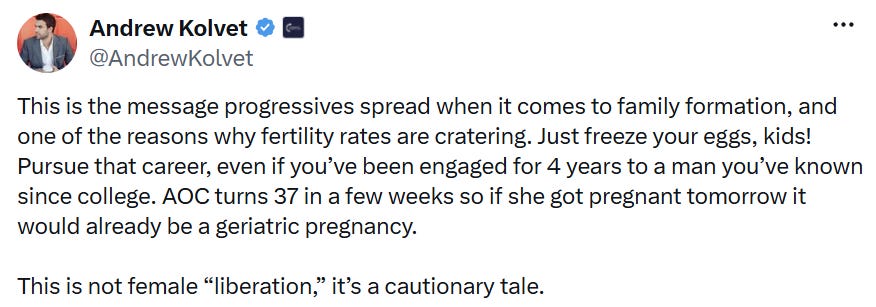
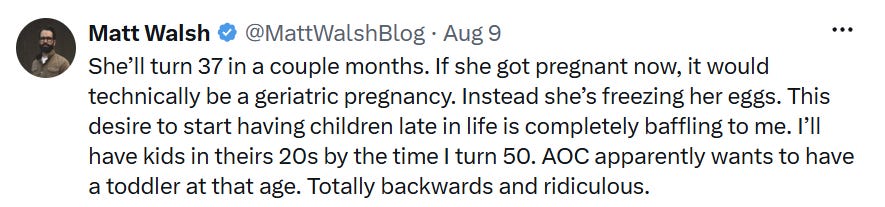
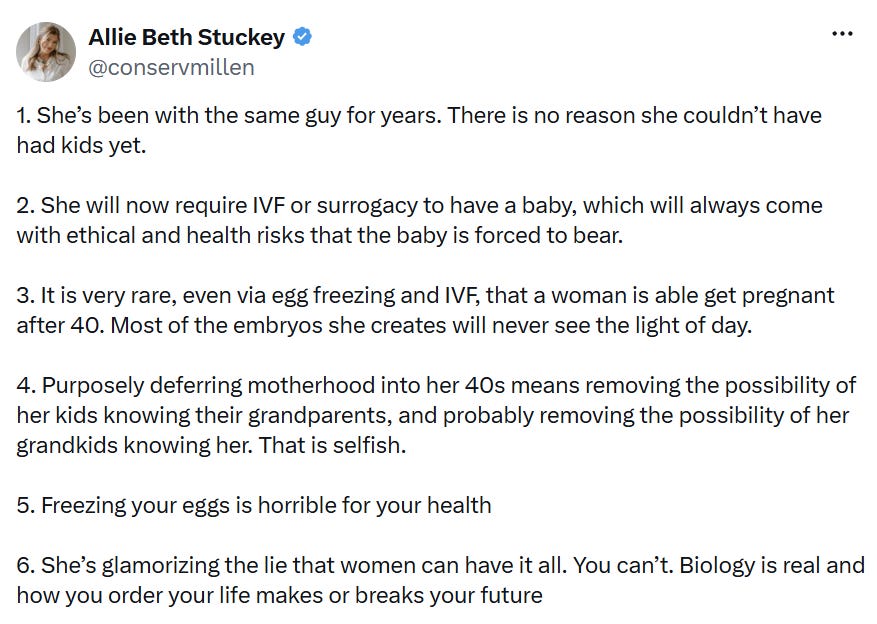
Matt Walsh’s and Allie Beth Stuckey’s criticisms were echoed by many in the comments. “Why not just try to get pregnant now?” “She’s doing it wrong.”
The Misogyny Tax
What AOC identified as a political tax is also something more specific: a misogyny tax.
With impeccable timing, Kate Manne just published this essay: The Misogyny Tax: On the bullshit our male counterparts do not have to deal with. She defines the misogyny tax as “the distinctive price women pay for using our voices, living our lives, or simply for existing in the world as it is currently.” In sharing her reproductive decision, AOC was simply living her life while being open and honest about something women of a certain age think about and plan for all the time.
In the essay, Manne names that ever-present question women ask themselves, “Would this have happened to my male counterpart?”
When it comes to the public scrutiny and questioning of AOC’s decision to freeze her eggs, the answer is: most definitely not. There is not a single man in Congress whose decision to delay having children beyond their mid-thirties was so newsworthy. There also is not a single man in Congress who has had to undergo the physically taxing medical procedure of freezing one’s eggs, to defend their reproductive choices, or to regularly answer questions about balancing their work-family priorities or “having it all.”
Alexandria Ocasio-Cortez, as a member of Congress, owes her constituents an explanation for how she represents them politically. She does not owe anyone an explanation for whether she plans to have children, when, or how.
The misogyny tax reduces her to her reproductive choices and timeline, which does not happen to her male counterparts.
Not to mention, if AOC had gotten pregnant in her late twenties or early thirties, it likely would have been called a distraction or a threat to her political career. Because she waited and froze her eggs instead, she's criticized for that. There's no version of the timeline where a woman's reproductive choices are just hers, off-limits to public opinion.
A Woman’s “Choice”
Whenever a woman’s choices are publicly scrutinized (even when the woman is a celebrity or public figure), there is often little discussion of the larger framework or system in which they are making those choices. We talk about individual “choices” without acknowledging the societal norms, institutional structures, laws, or policies that create the set of options we’re choosing from.
The discussion around AOC’s decision to freeze her eggs has been centered on either supporting or criticizing it as that—a personal decision. But what we should be asking is why she had to save up for several years in order to afford it. She shared this in one of her social media posts and has acknowledged that her decision came from a place of privilege, one many women can’t afford. Fertility treatments are rarely covered by insurance (in a system where insurance is often linked to employment, while women are being disproportionately pushed out of the workforce) and they’re not subsidized by the government.
While the fertility rate is declining and women are delaying motherhood at higher rates, the reason isn’t always fertility issues. Very often, their decision relates to the affordability of childcare and the overall cost of living, the affordability and availability of quality healthcare, financial uncertainty, and political instability.
Those are policy choices. And women are making these very personal decisions within a socioeconomic system that wasn’t designed by or for them.
There are many reasons Alexandria Ocasio-Cortez should be commended for bravely sharing her journey through this process. But while most people are taking sides as it relates to her personal decision, she is exposing how our laws and policies surrounding reproductive health and technology impact real people on a very intimate level. Although she is uniquely positioned to do this, it’s still a sacrifice and a public service that benefits people (especially women) navigating questions around their reproductive health and choices.
She is not only sharing such a personal decision, but being open and vulnerable, showing behind the scenes what this process looks like, and giving other women valuable insights and information. If only we could focus on making that process easier for her and everyone going through it.
I spend most of my free time reading and writing about current events and how they impact women because I believe it’s important. This kind of work takes time, energy, and care, and it’s work I choose to make free because I think access matters.
If you find value in my writing, becoming a paid subscriber is the most direct way to support it. Paid subscriptions make it possible for me to keep doing deep work like this and keep these posts accessible to everyone.
If you’re able, I’d really appreciate your support. And if you’re not, I’m still glad you’re here. Reading, sharing, and engaging with my posts is another way you can help. Thanks for being here.
You might like my Substack about TPUSA https://matthewboedy.substack.com/