

Fertility Rate Decline is Only a Problem If We Make It One

On Thursday, the Centers for Disease Control and Prevention (CDC) released provisional data showing the fertility rate for 2025 was 53.1 births per 1,000 women aged 15 to 44 (a 1% decrease from 2024), continuing a trend of declining fertility rates since about 2007.
The CDC numbers were widely reported on, but I want to address a point that is often overlooked.
CNN - US fertility rate dropped to another record low in 2025
NPR - US fertility rate hits historic new low as women delay pregnancy; U.S. birth rate continues to fall
Washington Post - U.S. fertility hits new low as teenage birth rate falls
Al Jazeera - US fertility rate drops to all-time low, continuing a two-decade decline
The New York Times - U.S. Fertility Rate Fell to Record Low in 2025, Extending Long-Term Decline
The Wall Street Journal - U.S. Birth Rate Hit a New Low in 2025

First, a few helpful definitions.
The general fertility rate (sometimes just called the fertility rate) is measured in terms of births per 1,000 women of reproductive age, and the birth rate is measured in terms of live births per 1,000 people in a calendar year. There are age-specific fertility rates, measuring the fertility rate in five-year increments. And the total fertility rate is the estimated number of children a woman would have if she experienced those age-specific fertility rates during her lifetime.
The Data
The fertility rate has been decreasing for decades, and this year’s (provisional) numbers are a continuation of that trend.
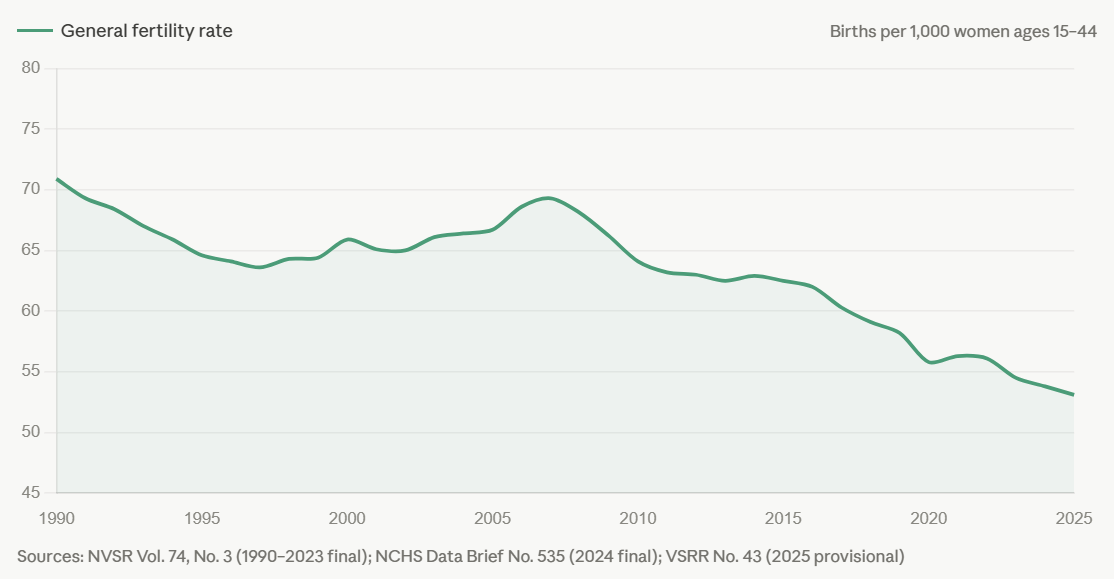
The decline starting in 2007, shown in the above graph, largely represents millennials and Gen X, plus some older Gen Z women and girls. (Peak millennials, like me, graduated high school in 2008.)
There are many factors that contribute to this decline.
It’s not only the Great Recession, but also the high cost of living that has continued (housing, childcare, student loans, etc.). It’s the result of women having more autonomy (access to education, reproductive autonomy, and feminist principles becoming more widely accepted). Those of us who grew up hearing the “girl power” message took it seriously. It’s also the result of policies that don’t adequately support young families, as well as people generally having more uncertainty/anxiety about the future.
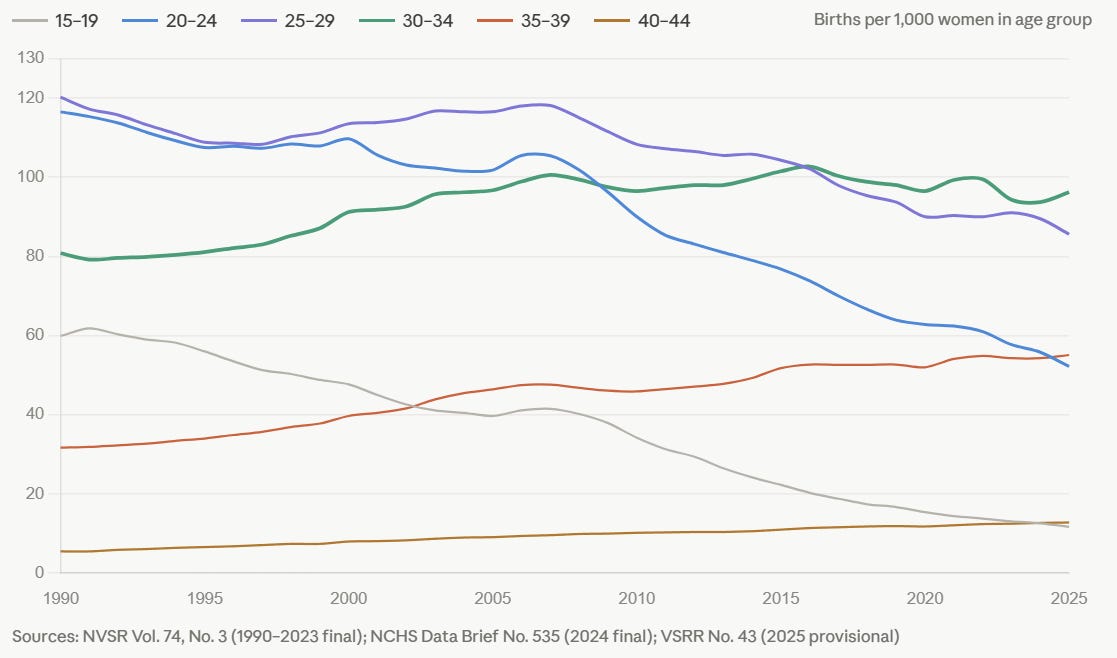
To get a better picture, it’s helpful to look at the age-specific rates. During this time, the fertility rate for women over thirty has been steady and slightly increasing. The fertility rate for women aged 25-29 has declined since 2007, but the largest decline has been for women under 24 and girls, with a significant decrease in teen pregnancies.
Why does the fertility rate matter? The main concern is economic. Social Security and Medicare are funded by current workers paying in to support current retirees. When birth rates fall, eventually, there are fewer workers and more retirees for them to support. A smaller workforce can also mean slower economic growth and the need to raise taxes.
The Right’s Crisis Messaging
On Thursday, Katie Miller (wife of Stephen Miller, one of Trump’s top advisors), posted this:
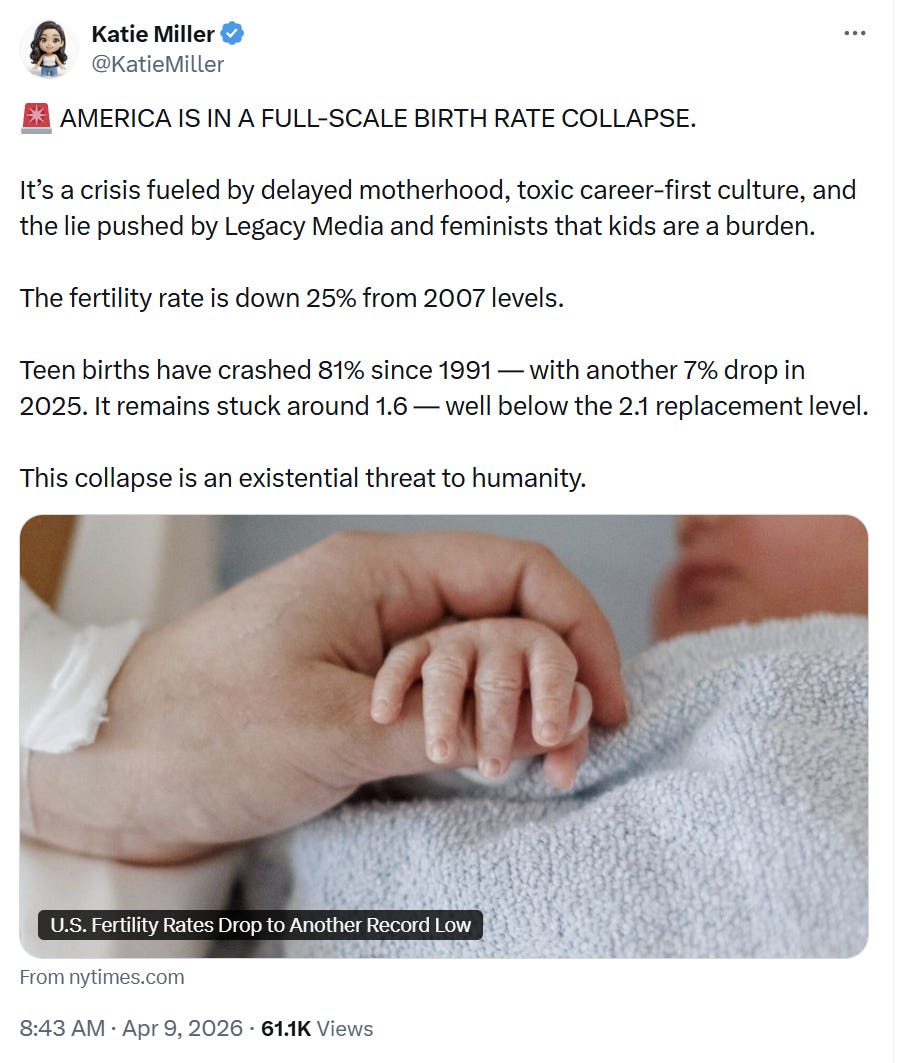
Teen births “crashing” is one way to put it. (In my opinion, an 81% decrease in teen births over a 35-year period is something to celebrate.) We shouldn’t pay too much attention to Katie Miller specifically, but this framing reflects a larger policy agenda.
In January, the Heritage Foundation published Saving America by Saving the Family: A Foundation for the Next 250 Years. It’s a 168-page report that, like Project 2025, is written for lawmakers and agencies, and it includes specific proposals for executive orders, federal laws and regulations, and state laws. The premise is that America is “in crisis” because of declining marriage and fertility rates.

The Heritage Foundation has real political influence, which is why we should care about their policy proposals, no matter how out of touch they seem. While mainstream reporting acknowledges the potential issues with declining fertility rates, Heritage and others on the right frame it as a crisis, largely as an excuse for implementing their agenda.
It Doesn’t Have to Be
To the extent the low fertility rate is a problem, it’s because we’ve structured our society in a way that relies on population growth to sustain itself economically. This structure also relies on a massive amount of unpaid labor, largely done by women.
But did anyone bother asking women whether they want to have 2.1 children before that structure was decided on? And if the real concern isn’t fertility, but population growth, couldn’t we change our immigration policies to encourage young families to immigrate?
The fertility rate is data that we should consider when making policy decisions. If increasing the fertility rate would be good for society, we should consider implementing policies that make it easier for people to have children (if they want to), and we should put women at the center of those policies.
Support My Work
I spend most of my free time reading and writing about current events and how they impact women because I believe it’s important. This kind of work takes time, energy, and care, and it’s work I choose to make free because I think access matters.
If you find value in my writing, becoming a paid subscriber is the most direct way to support it. Paid subscriptions make it possible for me to keep doing deep work like this and keep these posts accessible to everyone.
Data Sources:


