

Household Voting and the Overton Window
The fringe and the mainstream aren’t always as far apart as we’d like them to be.

Two Trump presidencies. Pandemic lockdowns. Overturning Roe v. Wade.
A lot of things have happened over the past decade that many of us didn’t expect. In the years before they happened, it might have felt like an overreaction to worry about them, to the extent they were on our radar at all (like the pandemic).

In 2026, there is a fine line between fear-mongering and facing reality.
Recently, the topic of household voting has appeared in more mainstream media outlets, including this piece in the New York Times.
Under a system of household voting, each “household” as opposed to each individual would have the right to vote. A married couple with children would get one vote, while a single person with or without children would also get one vote (unless they were considered part of another household, like their father’s). The argument sounds like this: “When two people get married, they become one under God, so married couples are basically being double counted. Is that really fair?”
To be clear, this is not going to happen. The purpose of this essay isn’t to convince you to worry about that; it’s to say that we should pay attention when extreme views start to become part of the everyday political conversation.
Household voting is a political non-starter because it’s not a belief held by enough people to make it viable. The vast majority of Americans are against it. Not to mention it disincentivizes marriage (by forcing people to give up their individual right to vote upon getting married), which is the opposite of what most conservatives want.
But when an idea like household voting becomes more widely discussed by mainstream media, as opposed to staying in the fringe of the fringe, it shifts the Overton window.
What is the Overton window?
The “Overton window” is a concept created in the 1990’s by Joseph Overton, a political scientist, and it helps to explain how unpopular ideas can end up in our laws and policies over time.
In her essay that introduced me to this idea, How the Overton Window Explains Normalizing Extremism Right Before Our Eyes, Emily Amick describes it this way:
The window of acceptable discourse moves the more we talk about things. They become ‘normalized.’ It’s not just about how ideas go from absolutely wild to totally normal, but how those very conversations are reflected in our policies. Yesterday’s radical notion might become tomorrow’s common sense that Congress considers actionable.
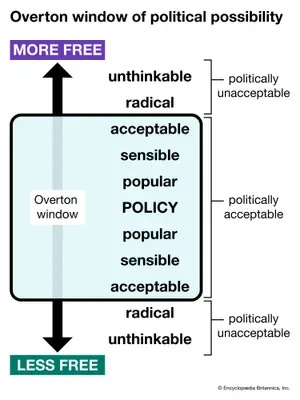
This process is accelerated by social media, the 24/7 news cycle and availability of news, and the constant flood of reactions to said news, which many of us consume all day every day.
The Overton window can shift on a specific issue, but the discourse can also affect related issues. For example, how is the discussion around household voting affecting the discourse around women’s rights and voting rights overall? When stories about something as extreme as household voting start to appear in the New York Times, CNN, and the Financial Times, how much does that shift the conversation on something like the SAVE Act, which is an attack on voting rights but pales in comparison to repealing the 19th Amendment, or the general idea that women should be submissive to men?
Who is spreading this idea?
Let’s start with the most extreme examples: Dale Partridge, Doug Wilson, and white Christian nationalists like them.
Dale Partridge is the lead teaching pastor at King’s Way Reformed Church and owner of an online Christian bookstore. It’s his church that is featured in the New York Times article, The Women Who Believe That Women Should Lose the Right to Vote. (Don’t let the title mislead you: the men believe it too.) You may have also seen him being ratioed on X or Threads for posts like these.
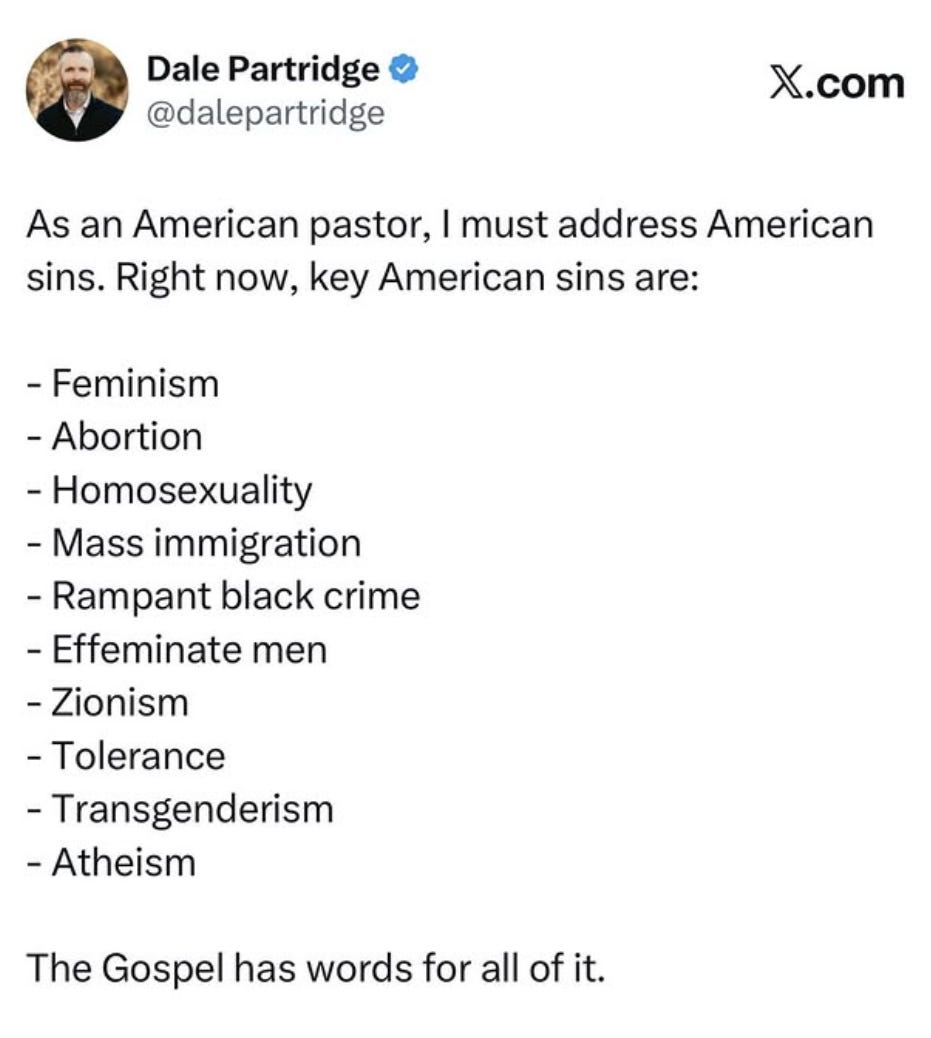
Despite the criticism, he has amassed hundreds of thousands of followers online, in addition to his church flock. The post above, which he shared on Instagram a few days ago, has 11,000 likes. Partridge openly advocates for repealing the 19th Amendment, believing that women shouldn’t have the right to vote and that they should subscribe to “male headship” at home and everywhere else.
Doug Wilson is the leader of Christ Church in Moscow, Idaho. Over the last couple of years, he has gained notoriety for his admittedly theocratic, white Christian nationalist views, his ties to Secretary of Defense Pete Hegseth (including leading a prayer service at the Pentagon in February), and his support for repealing the 19th Amendment.
Last year, he was interviewed by Pamela Brown at CNN, then he appeared in a follow-up CNN special in March of this year. In April, he appeared on Piers Morgan Uncensored where he was rightly embarrassed by Wahajat Ali. Just in the last week, he has been featured in the Atlantic (The Men Who Want Women To Be Quiet) and the Financial Times (Christian nationalist pastor Doug Wilson: ‘I’m starting a fight’).
While his media presence has picked up lately, it’s worth noting that he’s been well-known to many Christians for decades — Jemar Tisby recently did a whole podcast about him, which I highly recommend.

Household voting has roots in Biblical patriarchy, but it’s also spreading in more secular spaces like the manosphere and with younger Christians. Extremists like Nick Fuentes have repeatedly expressed interest in repealing the 19th Amendment, but it’s not only men. Popular conservative influencers Alex Clark and Savanna Faith Stone (each with hundreds of thousands of social media followers) have also spoken in support of household voting.
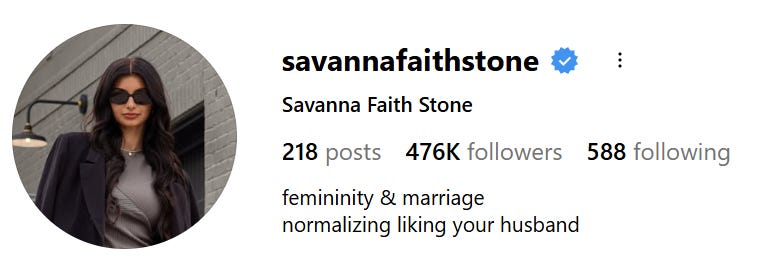
And their influence isn’t limited to Instagram. Twenty-year-old Savanna Stone is speaking at Turning Point USA next month, as is Alex Clark, a podcast host for the organization. They’ll be speaking at the Women’s Leadership Summit alongside women like Erika Kirk, Kayleigh McEnany, Judge Jeanine Pirro, and Allie Beth Stuckey.
Voting Rights Are Already Under Threat
On April 29, 2026, the U.S. Supreme Court issued its 6-3 decision in Louisiana v. Callais, gutting Section 2 of the Voting Rights Act.
As Justice Kagan put it in her dissent, "Today's decision renders Section 2 all but a dead letter. In the States where that law continues to matter — the States still marked by residential segregation and racially polarized voting — minority voters can now be cracked out of the electoral process."
Tennessee Republicans immediately called a special session and redrew their maps, eliminating the only majority-Black district (and only democrat-leaning district) in the state, replacing it with three majority-white and Republican-leaning districts. They openly admitted the goal was to gain Republican seats in Congress. Other red states have followed suit, while at the same time, the Virginia Supreme Court blocked the referendum where voters directly elected to redraw their maps in favor of Democrats.
On Saturday, thousands of people marched in Selma, Alabama to protest the Callais decision and the attack on voting rights across the country, specifically the voting rights of Black Americans. That’s not a sentence anyone should be reading or writing in 2026, but it’s happening.
Earlier this year, headlines about the SAVE Act were in every major news outlet, as it threatened to make voting more difficult for millions of people. The bill basically amounted to a poll tax, a form of voter suppression. It would have made it more difficult for anyone who had changed their name (as most women do after getting married) to register to vote, and it would have created an administrative burden keeping potentially millions of others from registering and voting.
Shifting the Discourse
Despite what people like Doug Wilson or Savanna Stone want, the 19th Amendment isn’t going anywhere. But ideas like household voting attempt to frame taking away a fundamental right as something more palatable. Even the phrase “household voting” is a meant to soften the practical reality that it would require repealing a constitutional amendment and stripping a fundamental right from tens of millions of people.
Most people don’t buy it, but when we’re exposed to an extreme idea enough times, particularly in mainstream media, at a minimum, it shifts the center of conversation on the issue and related issues. The SAVE Act might start to sound like “extra paperwork” that we shouldn’t mind doing for the security of our elections. (Never mind that our elections are already secure.)
Women’s suffrage was once radical. Black suffrage was once radical. So radical that we had to amend our constitution two separate times to solidify those rights, and so radical that we’re still fighting for them today. Household voting may be a fringe idea, but the gutting of the Voting Rights Act was real. The SAVE Act passing in the House was real.
The fringe and the mainstream aren’t always as far apart as we’d like them to be. When people are marching in Selma in 2026 to protect the same voting rights that generations of people fought and died for, the window has already shifted.
A Note on Supporting My Work
I spend most of what little spare time I have reading and writing about current events and how they impact women because I believe it’s important. This kind of work takes time, energy, and care, and it’s work I choose to make free because I think access matters.
If you find value in my writing, becoming a paid subscriber is the most direct way to support it. Paid subscriptions make it possible for me to keep doing deep work like this and keep these posts accessible to everyone.
If you’re able, I’d really appreciate your support. And if you’re not, I’m still glad you’re here. Reading, sharing, and engaging with my posts is another way you can help. Thanks for being here.